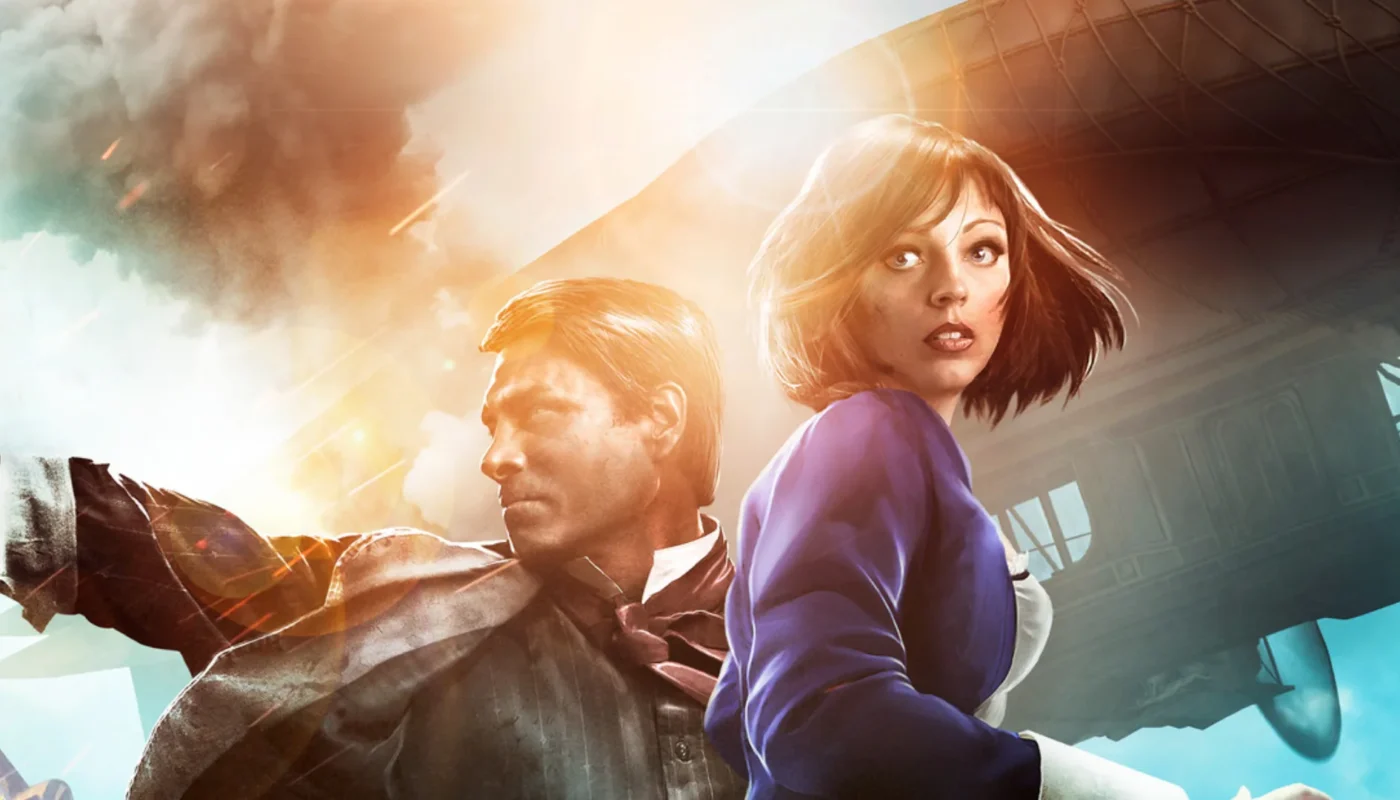
Imagine a city hidden beneath the Atlantic Ocean, where humanity’s greatest scientists, businessmen, and artists have gathered to build a perfect civilisation. There are no governments, no religious restrictions, and supposedly no limits to human achievement.
Now imagine another city floating above the clouds, where its citizens believe they are living in a divinely chosen paradise.
One city is called Rapture. The other is Columbia.
Both were created by men who believed they could build a better world. Both eventually became nightmares. And although their stories appear unrelated, the events of the BioShock franchise reveal that these cities are connected through something far more complicated than geography.
The BioShock timeline spans several decades, multiple realities, and some of the most memorable revelations in video game storytelling.
To understand everything, we need to start in 1890, long before Jack arrives in Rapture and long before Booker DeWitt reaches Columbia.
Warning: This article contains major spoilers for BioShock, BioShock 2, BioShock Infinite, Burial at Sea, and Minerva’s Den.
Table of Contents
1. 1890 – The Wounded Knee Massacre: The Beginning of Two Different Lives
(Image Credit Goes To: 2K / Irrational Games)
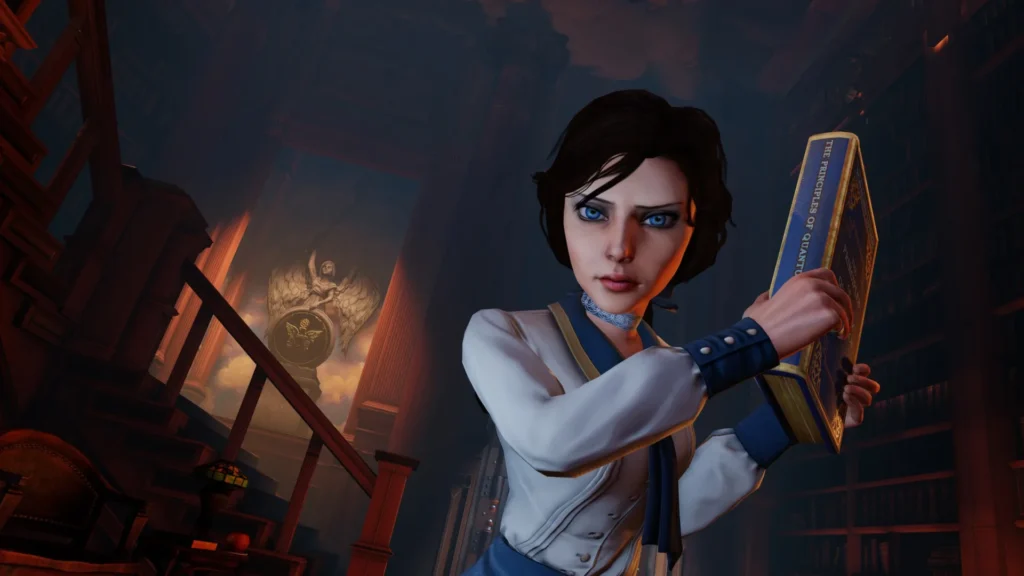
Our story begins with Booker DeWitt, a former soldier who participated in the Wounded Knee Massacre in December 1890.
The experience leaves Booker deeply troubled by his actions. Haunted by guilt, he struggles to move forward with his life.
Eventually, Booker is offered an opportunity to receive a religious baptism and begin again.
However, this is where the timeline takes an unexpected turn.
In one reality, Booker refuses the baptism. He continues living under his original identity and eventually becomes a private investigator.
In another reality, Booker accepts the baptism. He embraces religion, changes his identity, and becomes Zachary Hale Comstock.
These two men are actually different versions of the same person. One becomes Booker DeWitt, while the other becomes Comstock, the future ruler of Columbia.
This decision creates two different paths, and the consequences will eventually affect countless lives.
2. 1892–1893 – The Birth of Anna and the Creation of Elizabeth
In the reality where Booker refuses baptism, he marries and has a daughter named Anna DeWitt. Unfortunately, his wife dies during childbirth.
Booker becomes increasingly depressed, develops gambling problems, and accumulates considerable debt.
Meanwhile, in another reality, Comstock begins building his dream of a floating city.
After receiving visions of a magnificent city, he works with physicist Rosalind Lutece, whose research into quantum particles makes it possible to suspend structures in the air.
The city becomes known as Columbia.
However, Comstock has a problem. His exposure to the dimensional technology has left him unable to father a child. He wants an heir who can continue his legacy. And he knows exactly where to find one.
On October 8, 1893, Robert Lutece approaches Booker with an offer. In exchange for wiping away his debts, Booker must surrender his infant daughter, Anna.
Booker reluctantly agrees. But almost immediately, he regrets his decision and attempts to take Anna back.
Comstock takes the child through a dimensional tear. Booker tries to pull her back, but the tear closes during their struggle, severing a small part of Anna’s finger.
Comstock escapes with the child and renames her Elizabeth.
Elizabeth is raised in Columbia and eventually imprisoned inside Monument Tower because of her extraordinary ability to open tears into other realities.
The accident involving her finger leaves her connected to two different realities, providing an explanation for her unusual powers.
Another Reality: The Comstock Who Escaped to Rapture
There is another important branch of this story.
In an alternate reality, the transfer of Anna ends differently, and the child dies during the dimensional accident.
The Comstock from this reality cannot live with what has happened. Rather than continuing his life in Columbia, he eventually escapes through a dimensional tear into another reality.
This Comstock will become extremely important later. He eventually arrives in Rapture and adopts the identity of Booker DeWitt. His story becomes the foundation of the Burial at Sea expansions.
3. 1912 – BioShock Infinite: The City Above the Clouds
(Image Credit Goes To: 2K / Irrational Games)
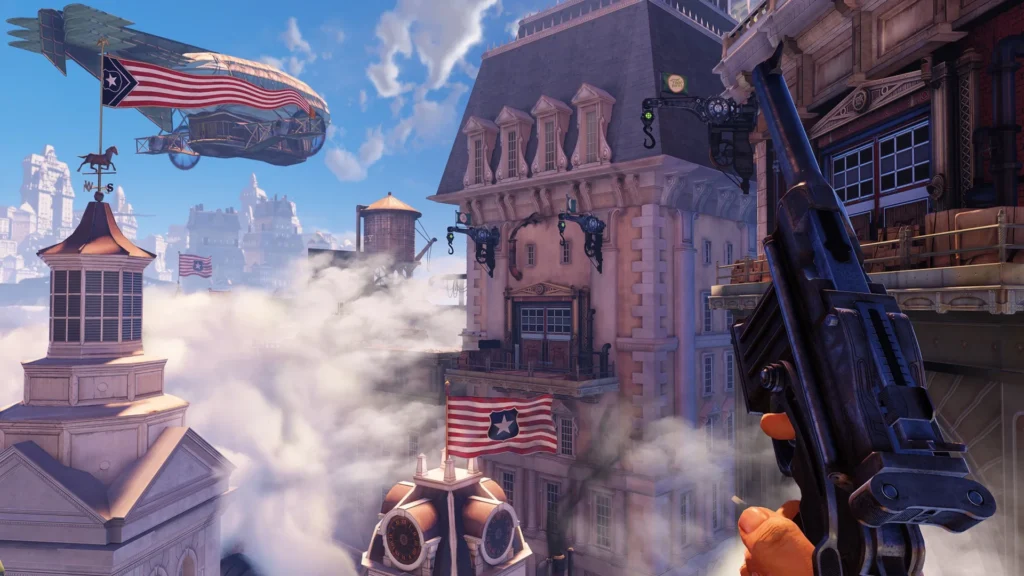
Years later, Columbia has become a magnificent floating civilisation.
However, beneath its beautiful architecture lies a society built on religious fanaticism, racial discrimination, and political oppression.
Columbia is ruled by Comstock, who presents himself as a prophet and demands unquestioning loyalty from its citizens.
Meanwhile, the original Booker DeWitt has become a private investigator. He receives an unusual assignment from Robert and Rosalind Lutece:
Bring us the girl and wipe away the debt.
Booker must travel to Columbia, rescue Elizabeth, and return her to the people who hired him.
He enters the city through a mysterious lighthouse and discovers a society unlike anything he has ever seen.
Eventually, Booker locates Elizabeth, who has spent most of her life imprisoned inside a tower under the protection of a giant mechanical creature known as Songbird.
After rescuing her, the two attempt to escape Columbia. However, their journey becomes increasingly dangerous as they become involved in the conflict between Comstock’s Founders and the revolutionary Vox Populi.
Elizabeth’s ability to open dimensional tears becomes essential to their survival.
During their journey, they encounter different versions of Columbia and discover that seemingly familiar events can have completely different outcomes in alternate realities.
Eventually, the truth about Booker, Comstock, and Elizabeth is revealed:
- Booker and Comstock are different versions of the same individual.
- Elizabeth is Anna DeWitt, Booker’s daughter.
- The Lutece twins have been manipulating events across multiple realities in an attempt to correct the consequences of their earlier decisions.
The Ending of BioShock Infinite
At the end of the game, Elizabeth takes Booker to a place beyond ordinary space and time.
She explains that countless realities exist, each containing different versions of the same people and events.
The only way to stop Comstock permanently is to prevent his existence. To achieve this, Elizabeth takes Booker back to the baptism following the Wounded Knee Massacre.
Booker understands what must happen. He allows Elizabeth and her alternate versions to drown him during the baptism, preventing the decision that creates Comstock.
One by one, the different versions of Elizabeth disappear. The ending suggests that Comstock’s existence has been erased across the realities connected to this event.
But there is still one mystery. A Comstock had already escaped into another reality before this final intervention. That is the version whose story continues in Burial at Sea.
The post-credits scene also returns us to October 8, 1893, where Booker awakens in his apartment and calls out for Anna. The scene deliberately leaves the final state of this reality open to interpretation.
4. 1945–1951 – Andrew Ryan Builds Rapture
(Image Credit Goes To: 2K / Irrational Games)
While the events involving Columbia unfold in the early twentieth century, another ambitious man is planning something extraordinary. His name is Andrew Ryan.
Following the destruction and political upheaval of the Second World War, Ryan becomes convinced that the surface world cannot offer the kind of freedom he desires.
He believes governments, religions, and social institutions interfere with the achievements of extraordinary individuals. His solution is to create an independent civilisation beneath the Atlantic Ocean.
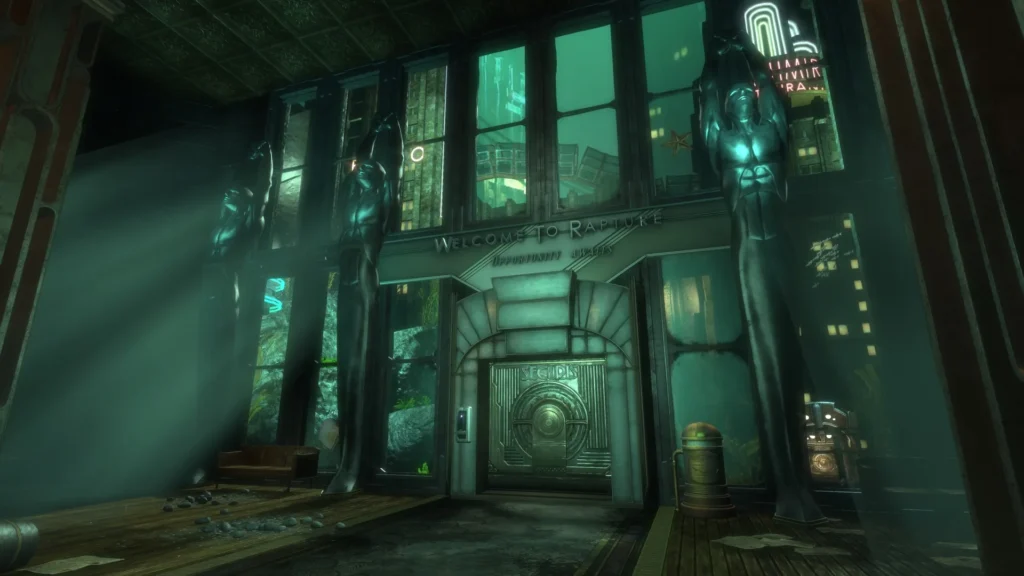
In 1945, Ryan announces his plans for Rapture. Construction begins in the North Atlantic, between Greenland and Iceland. Thousands of workers, engineers, architects, and scientists contribute to the enormous project.
By November 1946, the city is developed enough to receive its first residents. Construction continues for several more years, and by approximately 1951, Rapture has become the underwater metropolis Ryan envisioned.
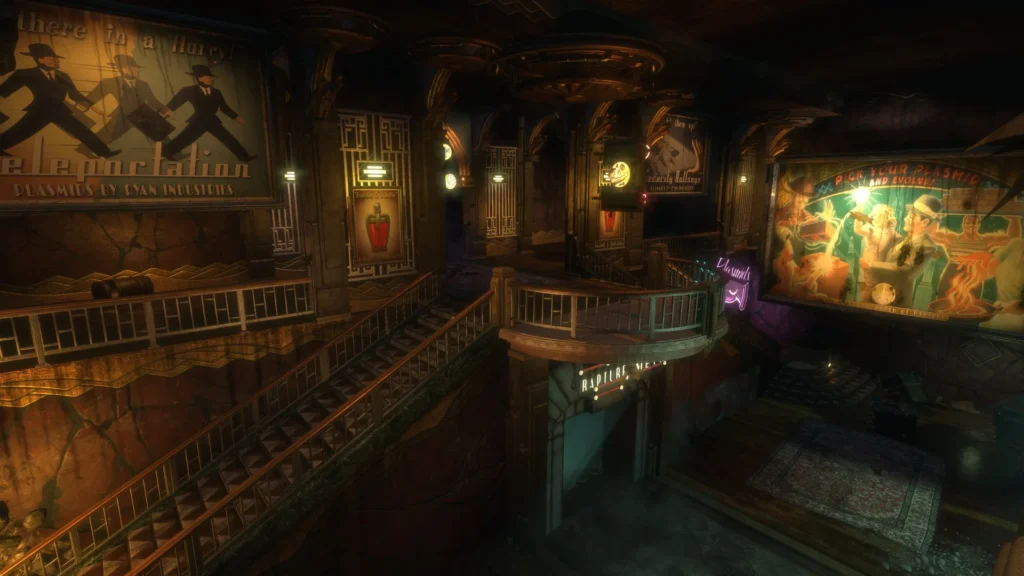
Its architecture is inspired by Art Deco, its economy celebrates private enterprise, and its citizens are encouraged to pursue their ambitions without restrictions.
Ryan’s famous philosophy becomes the foundation of the city:
No gods or kings. Only man.
For a while, Rapture seems to offer exactly what its creator promised. Unfortunately, its greatest strength will eventually become its greatest weakness.
5. The 1950s – ADAM, Plasmids, and the Beginning of Rapture’s Collapse
(Image Credit Goes To: 2K / Irrational Games)
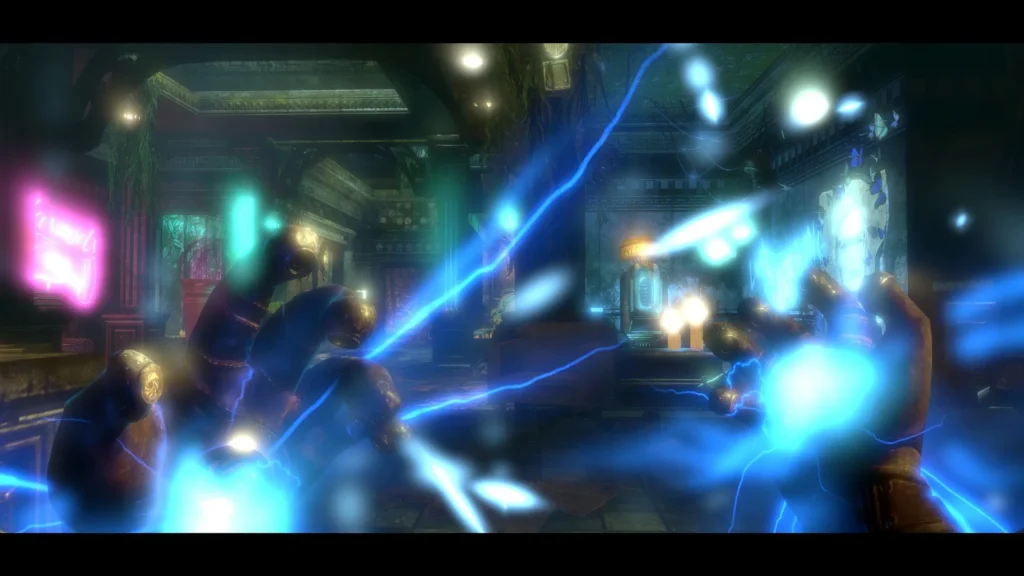
During Rapture’s early years, scientists discover ADAM, a substance derived from a sea slug. This discovery changes everything.
ADAM allows scientists to alter human genetic material, creating extraordinary abilities known as Plasmids. People can control electricity, produce fire, manipulate objects, and develop other supernatural powers.
Scientists begin experimenting with these substances, hoping to push the boundaries of human evolution.
However, ADAM has serious consequences. Repeated use causes physical and psychological deterioration. Citizens become addicted, increasingly violent, and eventually lose much of their humanity. These individuals become known as Splicers.
Another experiment leads to the creation of Little Sisters, children genetically modified to collect ADAM from dead bodies. To protect them, scientists develop heavily armoured guardians known as Big Daddies.
At the same time, the rivalry between Andrew Ryan and Frank Fontaine becomes increasingly dangerous. Fontaine builds a criminal empire and challenges Ryan’s authority over the city.
Political tension, economic inequality, ADAM addiction, and corruption gradually destroy the society that Rapture was supposed to represent. By the end of the decade, the city is approaching complete disaster.
6. December 31, 1958 – The Beginning of Rapture’s Civil War
(Image Credit Goes To: 2K / Irrational Games)
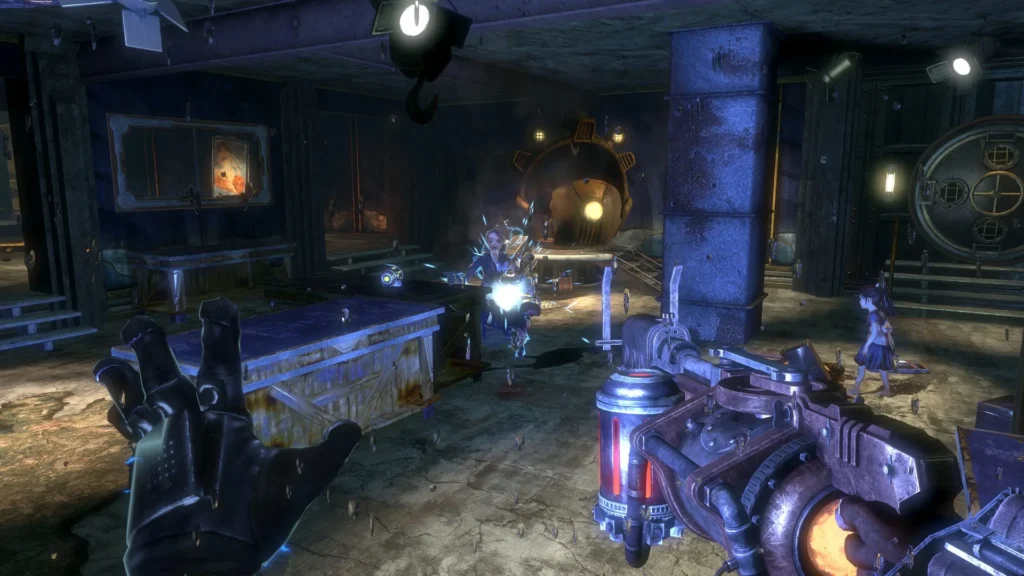
New Year’s Eve 1958 becomes one of the most important dates in the entire franchise.
Rapture’s citizens are celebrating the arrival of a new year when violence erupts throughout the city. The New Year’s Eve riots mark the beginning of the Rapture Civil War.
Two major stories unfold around this period.
BioShock 2: Subject Delta and Eleanor
The opening of BioShock 2 takes place on this date.
We are introduced to Subject Delta, an early Big Daddy prototype who shares a special connection with a young Little Sister named Eleanor Lamb. Unlike ordinary Big Daddies, Delta has been successfully bonded with a specific Little Sister.
However, Eleanor’s mother, Sofia Lamb, has other plans. She separates the pair and uses a Plasmid to control Delta, forcing him to shoot himself.
Delta dies, and Rapture continues descending into chaos. His story is not over, though. He will return ten years later.
Burial at Sea – Episode 1: The Mysterious Booker
The first Burial at Sea expansion also takes place on December 31, 1958.
We meet another version of Booker DeWitt, who works as a private investigator in Rapture.
A mysterious woman named Elizabeth approaches him and asks him to find a missing girl called Sally.
Booker agrees, and the investigation takes them through Rapture’s entertainment districts and eventually to Sander Cohen. Their search leads them to Fontaine’s Department Store, where Sally is hiding.
However, the investigation ends in tragedy. Booker attempts to force Sally out of hiding, putting her in danger. A Big Daddy attacks him, killing him.
The truth is then revealed. This Booker is actually the alternate Comstock who escaped to Rapture after losing Anna in another reality.
Elizabeth brought him into this investigation because she wanted him to face the consequences of his actions. But the story does not end with Booker’s death.
7. 1959 – Burial at Sea: Episode 2 and Elizabeth’s Final Sacrifice
(Image Credit Goes To: 2K / Irrational Games)
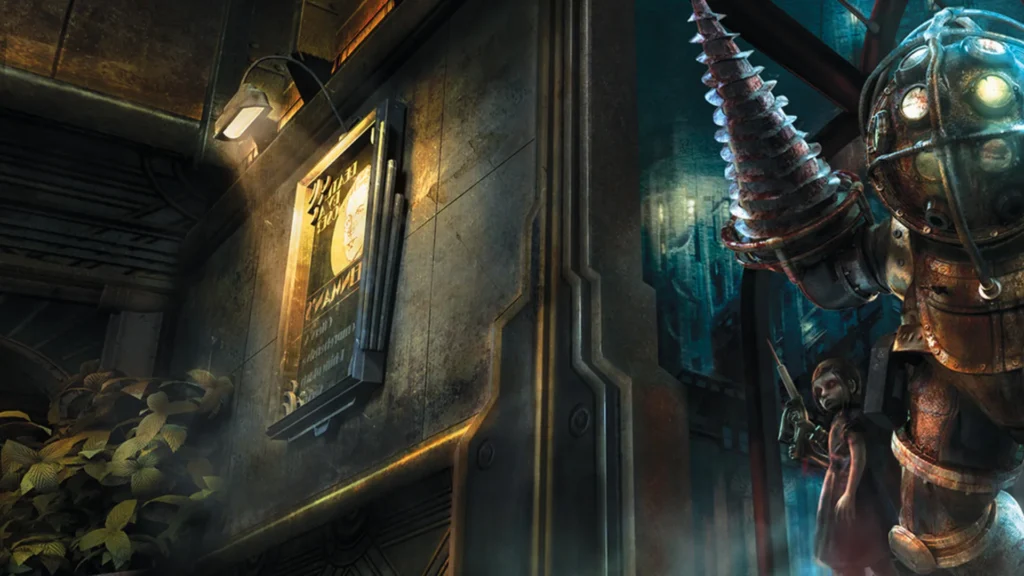
Following Booker’s death, Elizabeth continues her search for a way to save Sally.
She becomes involved with Atlas, who is secretly Frank Fontaine. Atlas wants to escape Fontaine’s Department Store and return to the larger Rapture, where he can continue his plans against Andrew Ryan.
Elizabeth makes a deal with him. She will help him escape if he returns Sally to her.
During her investigation, Elizabeth discovers something remarkable. Scientists in Columbia and Rapture have been exchanging technological knowledge through dimensional tears.
Dr. Yi Suchong in Rapture and Jeremiah Fink in Columbia have shared research, explaining the connections between technologies such as Plasmids, Vigors, Big Daddies, and Songbird.
Elizabeth also discovers the secret behind the mysterious phrase:
Would you kindly?
She realises that this phrase can be used to control Jack, the protagonist of the original BioShock. Atlas intends to exploit this psychological conditioning.
Elizabeth eventually retrieves the information he needs, knowing that it will help him manipulate Jack when the time comes.
She also encounters Dr. Suchong’s experiments and unknowingly helps complete the connection between a Little Sister and a Big Daddy.
During one of Suchong’s experiments, a Big Daddy becomes aggressive after the scientist strikes a Little Sister. It attacks and kills Suchong.
Elizabeth’s journey reaches its tragic conclusion when Atlas kills her. However, her actions have already set the next chapter of Rapture’s history in motion.
A young man named Jack will soon arrive in the city.
8. 1960 – BioShock: Jack Arrives in Rapture
(Image Credit Goes To: 2K / Irrational Games)
The year is 1960. An airplane travelling over the Atlantic Ocean crashes into the sea, leaving one survivor. His name is Jack.
After swimming towards a nearby lighthouse, he discovers a mysterious bathysphere that takes him deep underwater. He has arrived in Rapture.
Jack initially knows nothing about the city or its history. He receives a radio transmission from a man named Atlas, who promises to help him survive and escape.
As Jack explores the underwater metropolis, he encounters Splicers, Big Daddies, Little Sisters, and the consequences of Rapture’s collapse.
Eventually, Jack discovers the truth about the city’s founder, Andrew Ryan. Ryan is still alive, but his power is disappearing, and he knows that Jack has been manipulated.
The Truth Behind Jack
During their confrontation, Ryan reveals that Jack is actually his biological son. However, Jack was taken by Frank Fontaine and raised under psychological conditioning.
The mysterious phrase “Would you kindly?” was designed to make Jack obey commands without questioning them.
Atlas is not really an ordinary survivor. He is Frank Fontaine, the criminal mastermind who has been manipulating Jack from the beginning.
Ryan understands that Jack has never truly been making his own decisions. In one of the franchise’s most memorable scenes, Ryan forces Jack to demonstrate his obedience by killing him.
Before his death, Ryan delivers the famous line:
A man chooses. A slave obeys.
Jack eventually breaks free from his conditioning with the help of Brigid Tenenbaum and the Little Sisters.
He confronts Fontaine, who has transformed himself using enormous quantities of ADAM. Jack defeats him, bringing the main conflict of the original BioShock to an end.
Depending on how the player treats the Little Sisters, the ending can be hopeful or extremely dark.
The original game reveals the ultimate tragedy of Rapture: its founder’s dream of freedom was destroyed by greed, manipulation, and the desire for absolute power.
9. 1968 – BioShock 2: The Return of Subject Delta
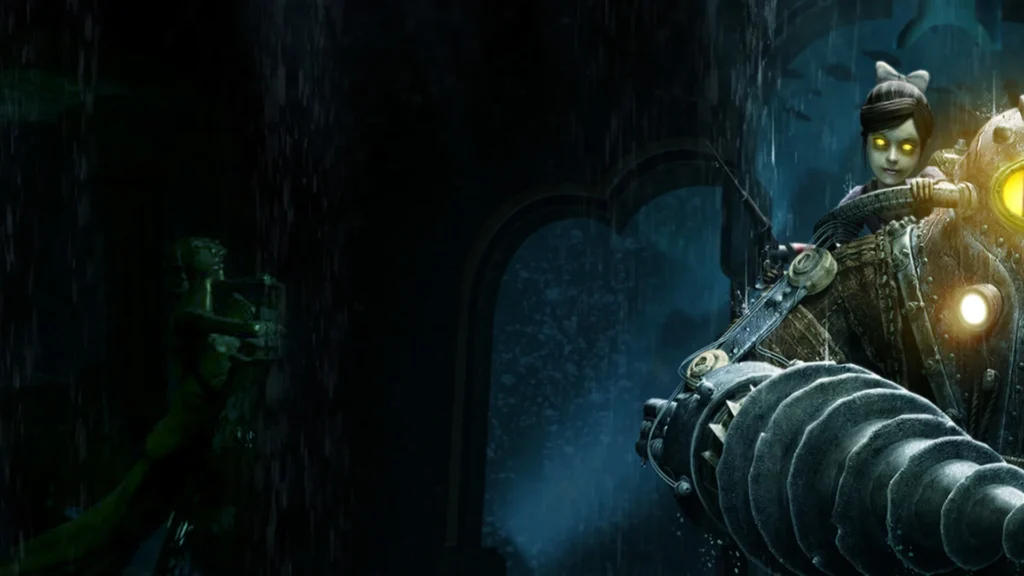
(Image Credit Goes To: 2K / Irrational Games)
Eight years after Jack’s arrival in Rapture, the city is still standing, but its condition has become considerably worse.
Andrew Ryan and Fontaine are gone. A new leader has taken control. Her name is Sofia Lamb.
Unlike Ryan, who believed in individual freedom and personal achievement, Lamb believes that humanity should work towards a collective purpose. She wants to create a society where individual desires are sacrificed for the greater good.
Her daughter, Eleanor Lamb, is central to this ambition.
Remember Subject Delta? The Big Daddy who was forced to kill himself in 1958? He is revived in 1968, with the help of Eleanor.
Delta now has one objective: find his Little Sister and reunite with her. However, Sofia Lamb controls much of Rapture and intends to prevent their reunion.
With the assistance of Brigid Tenenbaum and Augustus Sinclair, Delta travels through the ruined city, facing Splicers, Big Sisters, and Lamb’s followers.
As the story progresses, Delta’s actions begin influencing Eleanor’s personality and her understanding of humanity.
The game explores an important question: are people shaped by their experiences, or are they naturally good or evil?
Eventually, Delta and Eleanor attempt to escape Rapture. The final outcome depends on the player’s decisions throughout the game, particularly how Delta treats the Little Sisters and the people who stand in his way.
BioShock 2 gives us a different perspective on Rapture and explores the consequences of two competing philosophies.
10. 1968 – BioShock 2: Minerva’s Den
At approximately the same time as the main events of BioShock 2, another story unfolds in a secluded technological district of Rapture. This expansion is called Minerva’s Den.
We follow Subject Sigma, another Big Daddy, who is sent to retrieve important information about an advanced artificial intelligence system known as the Thinker.
The Thinker was created by Charles Milton Porter, a brilliant scientist who wants to recover his work and eventually escape Rapture.
However, the system’s development has become entangled with the ambitions of Reed Wahl, another scientist whose obsession with technology and prediction has destroyed his sanity.
As Sigma explores Minerva’s Den, he discovers the history behind the Thinker and Porter’s personal tragedy. The story explores identity, memory, artificial intelligence, and the meaning of humanity.
Although Minerva’s Den is separate from Subject Delta’s main journey, it takes place during the same general period in 1968.
It provides another glimpse into Rapture’s technological achievements and the consequences of its scientific experiments. It also delivers one of the most memorable standalone stories in the franchise.
11. The Complete BioShock Timeline at a Glance
Now that we have followed the story chronologically, here is a simple breakdown of the major events.
| Year | Major events |
|---|---|
| 1890 | Booker DeWitt participates in the Wounded Knee Massacre. |
| 1891–1892 | Booker faces the baptism that creates the alternate identity of Zachary Hale Comstock. |
| 1892–1893 | Columbia begins developing under Comstock’s leadership. |
| October 8, 1893 | Booker gives up Anna DeWitt. She is taken to Columbia and renamed Elizabeth in one reality. |
| 1912 | BioShock Infinite takes place in Columbia. |
| 1945 | Andrew Ryan announces the construction of Rapture. |
| 1946 | Rapture begins receiving its first residents. |
| 1946–1951 | Rapture continues expanding and becomes a functioning underwater civilisation. |
| 1950s | ADAM experiments, Plasmids, Fontaine’s criminal activities, and political instability contribute to Rapture’s decline. |
| December 31, 1958 | The Rapture Civil War begins. BioShock 2’s opening flashback and Burial at Sea Episode 1 take place around this period. |
| 1959 | Burial at Sea Episode 2 takes place. Elizabeth helps set Jack’s story in motion. |
| 1960 | The original BioShock takes place. Jack discovers Rapture and confronts Andrew Ryan and Fontaine. |
| 1968 | The main story of BioShock 2 and the events of Minerva’s Den take place. Subject Delta returns to Rapture. |
Important: The BioShock timeline contains alternate realities and dimensional travel. Some events happen in separate branches, so not every event can be placed into one perfectly continuous history. The dates above represent the main chronological progression.
12. What Is the Correct Chronological Order to Experience BioShock?
For someone who wants to follow the events according to their in-universe chronology, the following sequence is useful:
- BioShock Infinite – 1912, Columbia.
- BioShock 2 – Opening flashback – December 31, 1958, Subject Delta and Eleanor.
- Burial at Sea – Episode 1 – December 31, 1958, Rapture.
- Burial at Sea – Episode 2 – 1959, Elizabeth’s final story.
- BioShock – 1960, Jack’s arrival in Rapture.
- BioShock 2 – Main campaign – 1968, Subject Delta’s return.
- BioShock 2: Minerva’s Den – 1968, a parallel story in Rapture.
The opening flashback of BioShock 2 belongs in 1958, even though its main campaign takes place in 1968. Minerva’s Den also takes place during the BioShock 2 period, so there is no need to force an exact order between the two campaigns.
For first-time players, release order is still the better way to experience the franchise’s revelations. Chronological order is primarily useful for understanding the complete history.
BioShock Timeline FAQ
What is the correct BioShock timeline order?
The in-universe order is BioShock Infinite (1912), the BioShock 2 opening flashback and Burial at Sea Episode 1 (December 31, 1958), Burial at Sea Episode 2 (1959), BioShock (1960), and finally BioShock 2 and Minerva’s Den (1968).
Is BioShock Infinite a prequel to BioShock?
Partly. BioShock Infinite is set in 1912, decades before Rapture falls, but it is mainly connected to the Rapture games through the Burial at Sea DLC and the multiverse, not as a direct prequel.
Are Booker DeWitt and Comstock the same person?
Yes. Comstock is a version of Booker DeWitt who accepted the baptism after the Wounded Knee Massacre in 1890, while Booker is the version who refused it.
Who is Jack in BioShock?
Jack is Andrew Ryan’s biological son. He was conditioned by Frank Fontaine to obey any order that includes the phrase “Would you kindly?”.
Should I play BioShock in chronological or release order?
Play in release order (BioShock, BioShock 2, BioShock Infinite, then Burial at Sea) so the big twists land properly. Chronological order is best for understanding the full story afterwards.
Final Thoughts: Two Cities, One Endless Cycle
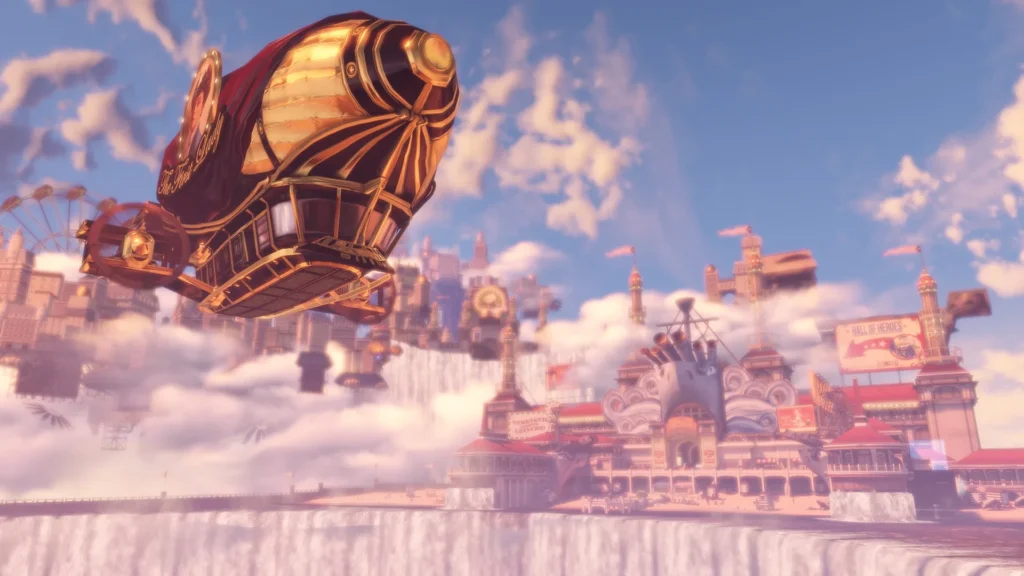
(Image Credit Goes To: 2K / Irrational Games)
The BioShock franchise is much more than a collection of first-person shooters. It is a story about ambition, freedom, identity, morality, and the consequences of human decisions.
Andrew Ryan wanted to create a civilisation where individuals could achieve anything without interference, but his philosophy failed to account for greed and the desire for power.
Zachary Hale Comstock wanted to create a perfect society based on his own beliefs, but his obsession with controlling the future eventually destroyed him.
And Booker DeWitt became the centre of a story where a single decision created countless realities.
Rapture and Columbia may look completely different, but their histories share a similar tragedy. Both cities were built by men who believed they had discovered the perfect way to organise humanity. Neither understood that the greatest threat to their dreams was human nature itself.
Perhaps that is what makes BioShock so memorable. There is always a man. There is always a city. And there is always a lighthouse.
Love deep dives into game lore? Read our Alan Wake Timeline Explained: From Bright Falls to the Dark Place and check out our list of the best story games of all time.
Would you kindly tell us which BioShock game is your favourite in the comments?
Follow MovieAnimeX for more video game stories, timelines, character explanations, and deep dives into fictional worlds.
Image Credit Goes To: 2K Games / Irrational Games. All BioShock images are official screenshots and remain the property of their respective owners.